
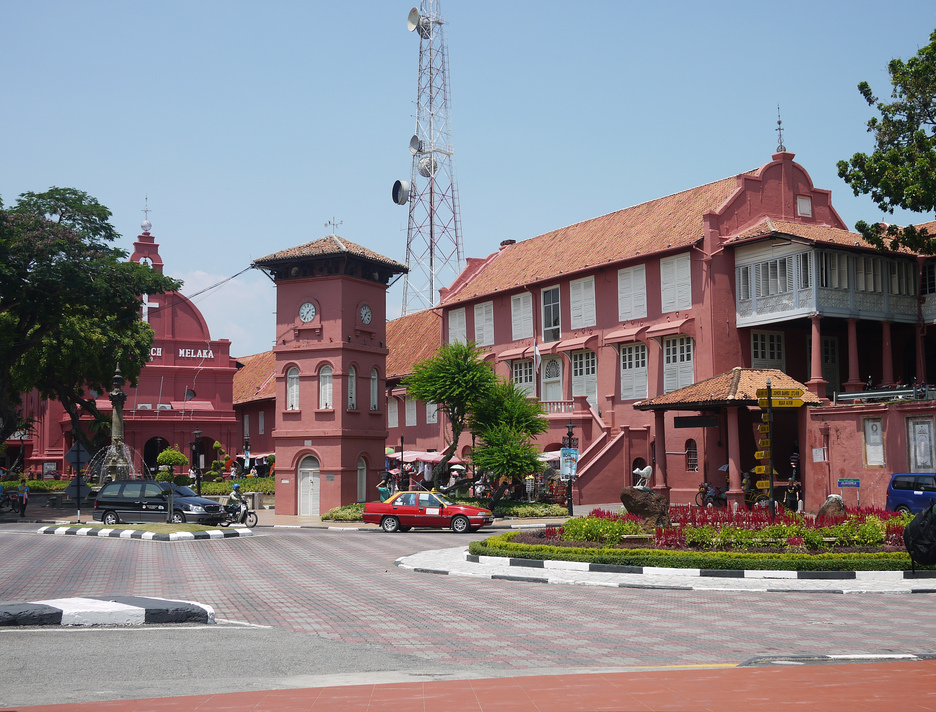
Jerine Lay; derivative work MrPanyGoff / CC BY 2.0, Wikimedia Commons. Historical image uploaded in 2012; unchanged file with responsive display. It does not establish today's road layout, access or crowds.
First, separate a square from its individual landmarks
Treat Dutch Square as a setting, not a ticket product or a single building name. On your own photograph, try to identify four different forms: the low, long Stadthuys building, the church frontage, the freestanding clock tower and the fountain. Use signs and a reliable reference when an identification is uncertain; colour alone is not enough.
A useful family question is: which object looks like a place people entered to work, which served worship, and which addresses people outside? That is an observation exercise, not historical proof. It gives younger visitors a reason to look twice without asking them to memorise every date before the trip.
When asking for a quote
Send hotel, passengers, luggage and return timing together
Complete details make it easier to check vehicle fit, rest stops and timing without unnecessary back-and-forth.
Stadthuys and Christ Church: different roles, different dates
Tourism Melaka identifies Stadthuys as the Dutch governor's administrative building dating to 1650, and dates Christ Church to 1753. These two facts already challenge the idea that everything red belongs to one construction project. One helps you ask about administration; the other about religious life.
Do not turn an exterior identification into a claim that you have seen the interior. Looking at a facade, entering a church and visiting a museum are separate experiences. If one of those interiors matters to you, check its own visitor information rather than treating a stop at the square as confirmation that every door will be open.
The clock and fountain add local stories
Karen Woo's 2020 account for Museum Volunteers, JMM records a guided explanation that the clock tower and fountain were local contributions rather than Dutch constructions. The account connects the clock tower with a Melakan Baba who prospered in Singapore, and the fountain with a commemoration of Queen Victoria. It is that author's attributed account, not a tour we conducted.
This changes the question from 'Which colonial country built the square?' to 'Who contributed to this place, and what did they want people to remember?' Read any accessible inscription carefully and distinguish what you can actually see from what a guidebook explains. If two sources give different details, keep the uncertainty rather than filling the gap with a confident story.
Try a three-question photograph, not another checklist
Before leaving, choose one photograph and answer three questions together: what object is this; what was its stated function; and which part of our explanation came from a source rather than the image? A clock face can be visible in a photograph. The donor's life or a building's former function usually needs another source.
For example, a family could compare the church and clock tower in one frame, then write a short caption that does not call both 'Dutch buildings'. This is a suggested activity, not a real customer story. It suits curious visitors who enjoy looking closely; a group seeking only a quick picture can keep it shorter and save the reading for later.
Choose one follow-up, and keep the visit respectful
If the government-building story interests you, investigate the Stadthuys museum information. If religious architecture is the priority, check the church's current visitor arrangements and follow posted guidance. You do not need to add every nearby attraction to make the square worthwhile. One answered question can be more memorable than several hurried entrances.
Do not use this historical photograph to decide where it is safe to stand or where a vehicle can wait today. Observe current barriers, traffic and pedestrian directions; avoid blocking entrances for a photograph. Rest needs, weather and the group's interest should determine how long you stay. This guide deliberately does not promise a fixed walking time, free entry or step-free access.
Fit the heritage stop into the Melaka trip
For a Singapore-to-Melaka enquiry, describe whether Dutch Square is your main visit, one declared stop or somewhere you will explore after hotel arrival. Use the route page below to confirm the actual arrival and collection arrangement. A landmark photograph is not a confirmed pickup point, and a transfer does not automatically include a guided tour or museum tickets.
Historical sources were reviewed on 26 October 2026. Their history sections do not establish today's admission conditions. Check current venue notices for any interior you plan to visit; keep the transport confirmation and attraction arrangements distinct.